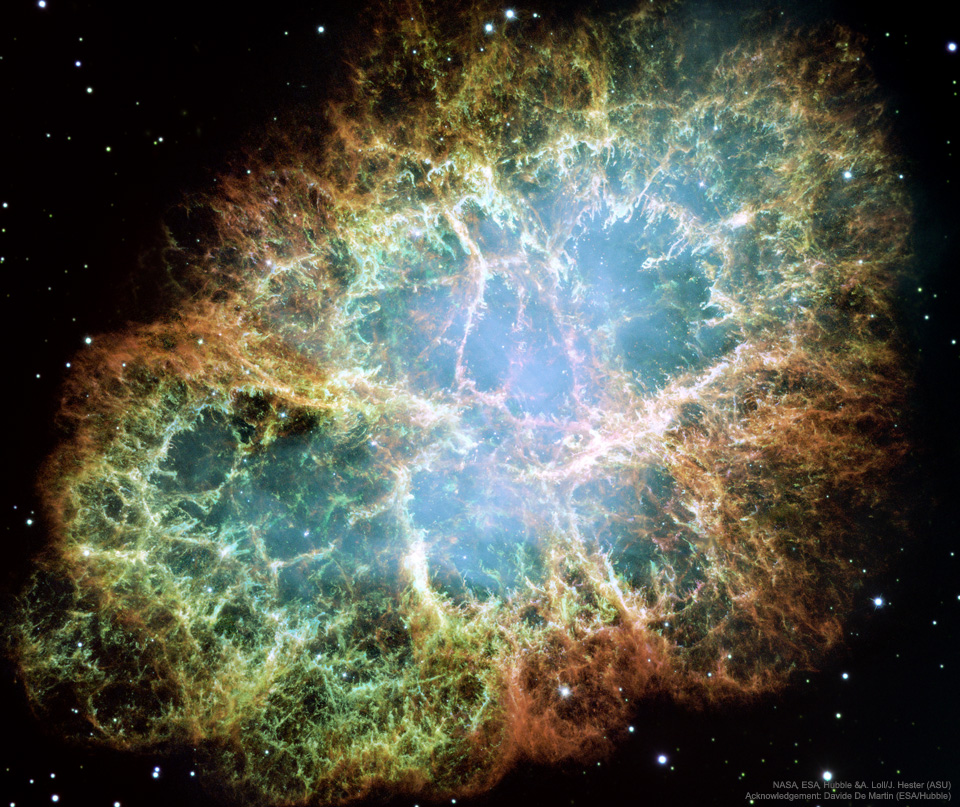
M1: The Crab Nebula from Hubble
Copyright: Public Domain
Model: gemini-2.0-flash-exp
Prompt version: 1.0
Model: gemini-2.0-flash-exp
Prompt version: 1.0
This is the mess that is left when a star explodes.
The Crab Nebula, the result of a Supernova seen in 1054 AD, is filled with mysterious filaments. The filaments are not only tremendously complex, but appear to have less mass than expelled in the original Supernova and a higher speed than expected from a free explosion.
The featured image, taken by the Hubble Space Telescope, is presented in three colors chosen for scientific interest. The Crab Nebula spans about 10 light-years. In the Nebula’s very center lies a Pulsar: a neutron star as massive as the Sun but with only the size of a small town. The Crab Pulsar rotates about 30 times each second.