From the Pleiades to the Eridanus Loop
Model: gpt-4.1-mini
Prompt version: 1.0
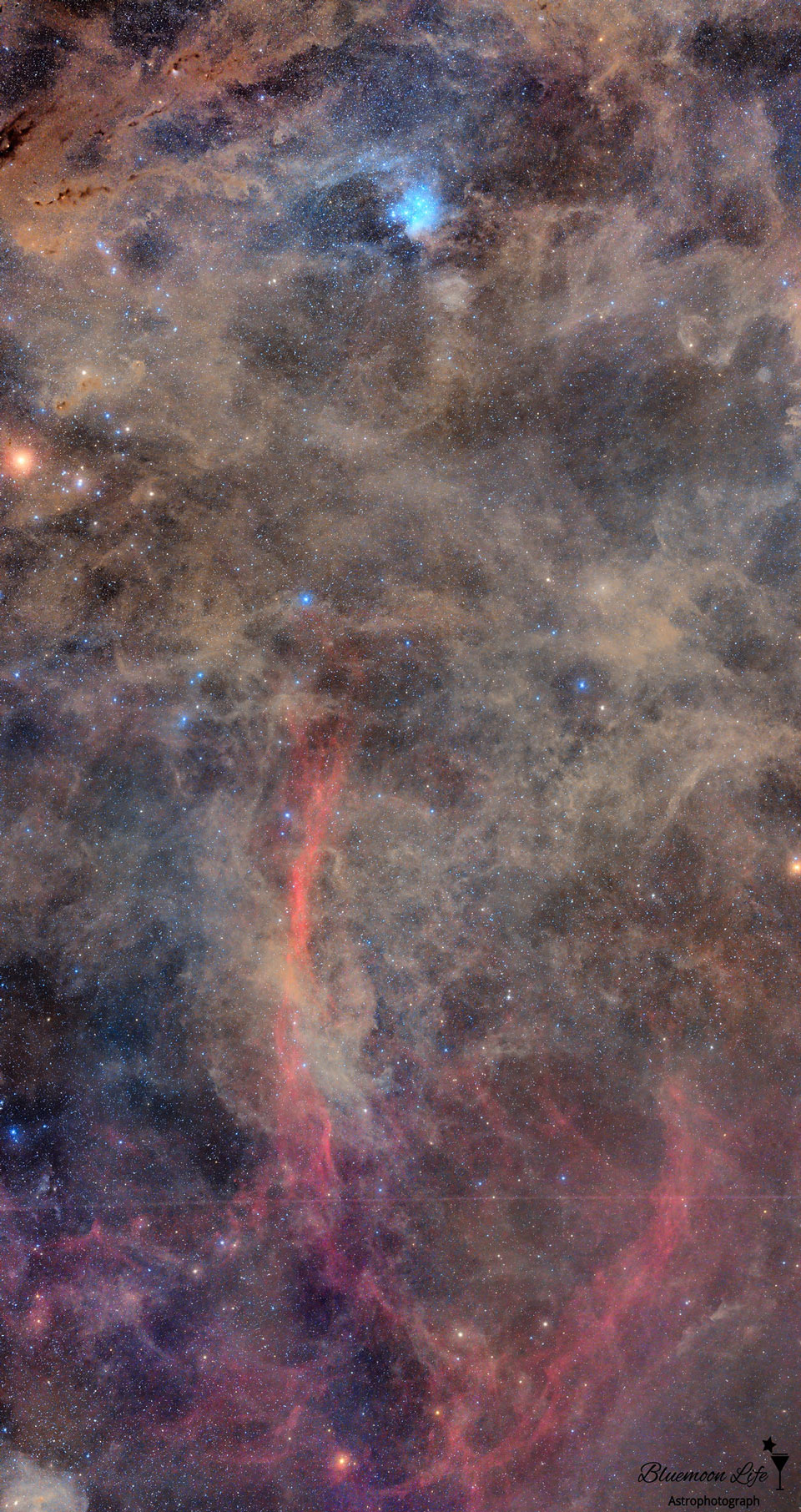
If you stare at an interesting patch of sky long enough, will it look different? In the case of Star Cluster Pleiades and Star Cluster Hyades — and surrounding regions — the answer is: yes, pretty different.
Long duration camera exposures reveal an intricate network of interwoven Cosmic Dust and gas that was previously invisible not only to the eye but to lower exposure images. In the featured wide and deep mosaic, the dust stands out spectacularly, with the familiar Pleiades star cluster visible as the blue patch near the top of the image.
Blue is the color of the Pleiades’ most massive stars, whose distinctive light reflects from nearby fine dust. On the upper left is the Hyades star cluster surrounding the bright, orange, foreground-star Aldebaran.
Red glowing Emission Nebula highlight the bottom of the image, including the curving vertical red ribbon known as the Eridanus Loop. The pervasive dust clouds appear typically in light brown and are dotted with unrelated stars.
Almost Hyperspace: Random APOD Generator