The Pleiades: Seven Dusty Sisters
Model: gpt-4.1
Prompt version: 1.0
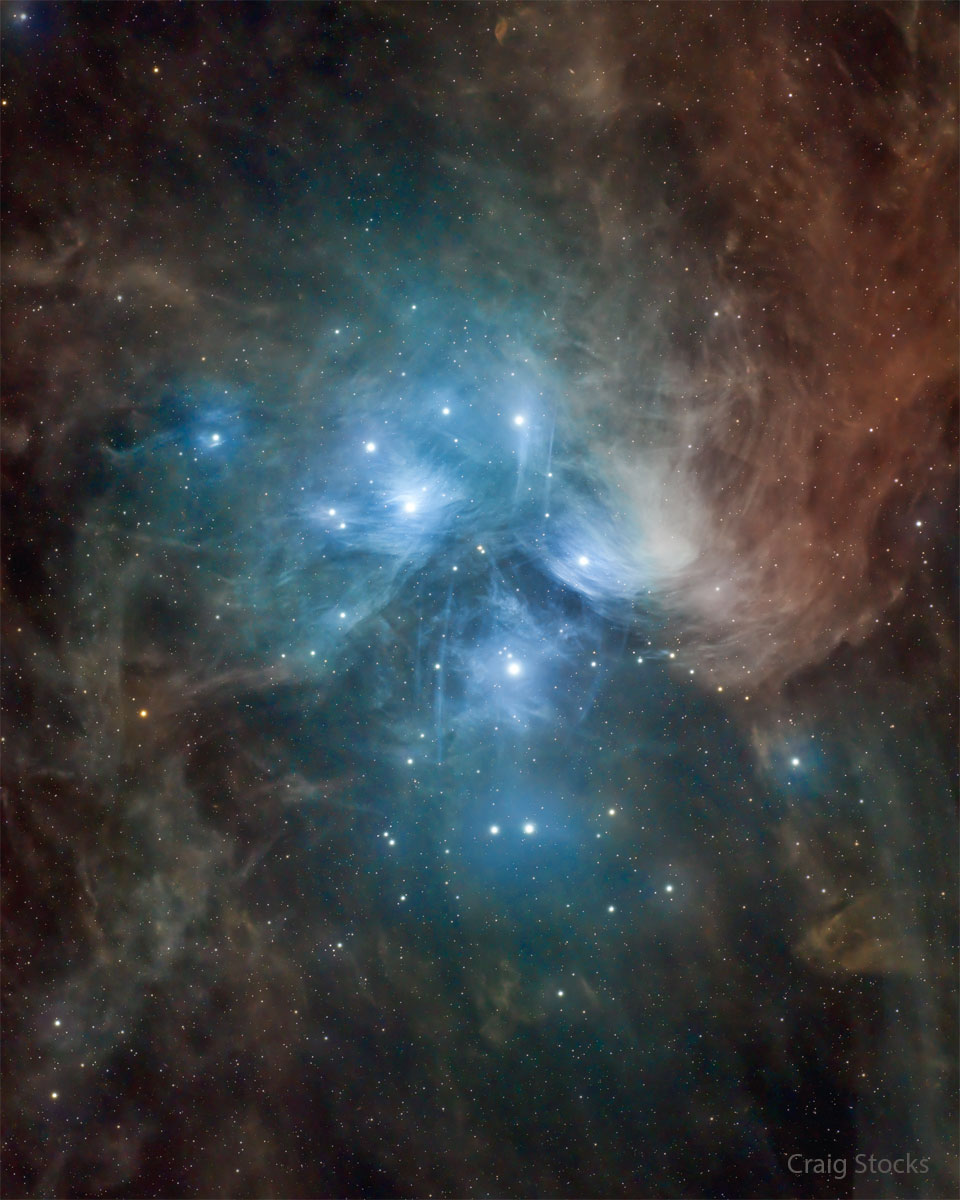
The well-known {Pleiades} {Star Cluster} is slowly destroying part of a passing cloud of gas and {Cosmic Dust}. The {Pleiades} is the brightest open cluster of stars on Earth’s sky and can be seen from almost any northerly location with the unaided eye.
Over the past 100,000 years, a field of gas and {Cosmic Dust} is moving by chance right through the {Pleiades Star Cluster}, and is causing a strong reaction between the stars and {Cosmic Dust}. The passing cloud might be part of the {Radcliffe Wave}, a newly discovered structure of gas and {Cosmic Dust} connecting several regions of star formation in the nearby part of our {Milky Way} {Galaxy}.
Pressure from the stars’ light significantly repels the dust in the surrounding blue reflection {Nebula}, with smaller dust particles being repelled more strongly. A short-term result is that parts of the dust cloud have become filamentary and stratified.
The featured deep image incorporates nearly 9 hours of exposure and was captured from Utah Desert Remote Observatory in Utah, USA, last year. This is an impressive example of {Astrophotography} capturing the {Celestial} wonders visible in our {Night Sky}.