Dust Shells around WR 140 from Webb
Model: gpt-4.1
Prompt version: 1.0
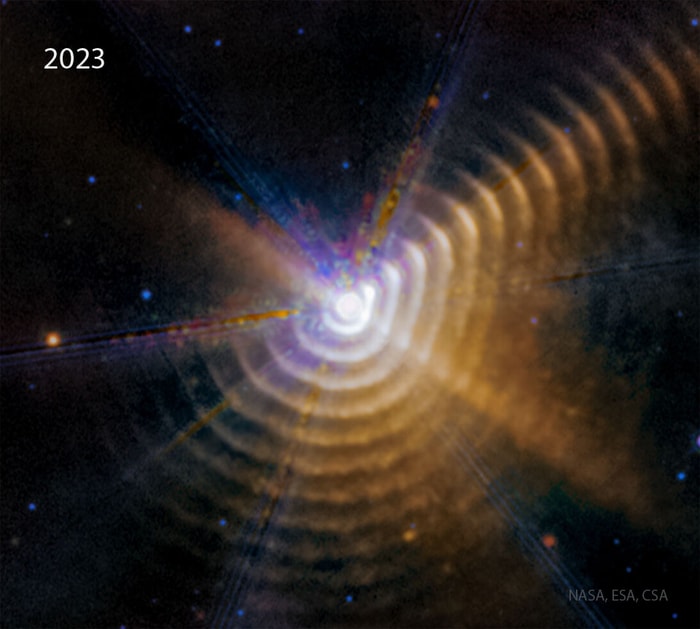
What are those strange rings? Rich in dust, the rings are likely 3D shells — but how they were created remains a topic of research.
Where they were created is well known: in a binary star system that lies about 6,000 light years away toward the constellation of the Swan (Cygnus) — a system dominated by the Wolf-Rayet star WR 140.
Wolf-Rayet stars are massive, bright, and known for their tumultuous winds. They are also known for creating and dispersing heavy elements such as carbon, which is a building block of interstellar dust and cosmic dust.
The other star in the binary star system is also bright and massive — but not as active. The two great stars joust in an oblong star orbit as they approach each other about every eight years. When at closest approach, the X-ray emission from the system increases, as, apparently, does the dust expelled into space — creating another shell.
The featured infrared image by the Webb Space Telescope resolves greater details and more space clouds and dust shells than ever before. Images taken over consecutive years show the shells moving outward.
These observations are stunning examples of astrophotography at the limits of current technology.